Sunday, January 27, 2008

Sea Bass Poached in Homemade Creamy Curry Sauce


When you have the proper tools and good music, cooking is so easy and fun! Upbeat loungy jazz music is a great motivator for cooking. At least, for me, it makes me feel like I'm cooking in a posh restaurant kitchen. One can always fantasize. As I feel the beat of the music, I sample, test, try, and savour until I get the "right" desired texture and taste. That's what cooking is all about. There is nothing more satisfying than to let yourself go and let your imagination do the work for you. You'll be surprised how easy it is to concoct a culinary creation.
**
For people on the go, this recipe is fast and almost effortless. It only takes 10 minutes of preparation and 10 minutes of cooking. Making your own curry paste is surprisingly simple and rewarding. All you need are the right spices & herbs and a mortar. The spices illustrated below can be purchased in any local asian or arabic grocery store.
**
THE SPICES
From left to right : minced garlic, minced ginger, tomato paste, ground paprika, ground tumeric (or curcuma), chili powder, ground cumin, garam masala.
Top Center: Fresh coriander and one quarter lemon.
***

When blended and crushed, these spices make a wonderfully aromatic curry paste, both intense and vibrant in colour. The key to making a colourful paste is squeezing in fresh lemon juice. Since I started making my own homemade curry paste, I can't go back to the ones already pre-made from the store.
****
Recipe "au pif":
1 1/2 lbs Sea Bass filet (2 big nice filets cut in nice chunky pieces - skin removed)
1/2 cup chicken broth
1/2 cup of 15% "Champetre" or "Country-style" cream (thicker than regular 15% cream, or use 35% cream)
1/3 cup coarsely chopped fresh coriander
*
DRY SPICES (most found in local asian or arabic grocery stores):
1 tsp minced garlic
1 tsp minced ginger
1 tsp ground paprika
1 tsp tumeric (or curcuma)
1 tsp chili powder
1 tsp ground cumin
1 tbsp ground garam masala
1 tsp coarse sea salt
----
1 tbsp tomato paste
Juice of 1/4 lemon
1 tbsp olive oil**
Making the vibrant curry paste:
Grind and blend the above dry spices in the mortar. Squeeze in the lemon juice and add in the tomato paste. Blend well until you reach a paste texture. Put aside.
*
Preparing the fish dish:
In a large saute pan, heat the oil over moderate heat. Add the curry paste and cook, stirring, until fragrant, about 30 seconds. Add the chicken broth and stir until there are no more lumps. Add in the cream and stir until sauce is velvety and bubbly.
**
Arrange the fish in the pan and gently shake the pan so the fish is coated with the sauce. Cover and cook until the fish flakes easily with a fork, about 7 minutes.
**
Sprinkle chopped cilantro over the fish.
**
Ladle the sauce over the fish and serve with rice.

Sunday, January 20, 2008

Roasted Pork Loin with Fragrant Szechuan Pepper and Sage

This pork roast is amazingly juicy, tender and flavourful. Once again, I used the brown paper bag method to trap the moisture in the meat while roasting. For the flavour, I used a very aromatic spice, called Szechuan peppercorn, mainly found in Chinese and Tibetan cooking. I started using Szechuan peppercorn only recently after reading about it in Chinese cooking books.

Szechuan peppercorn is described as an asian spice related to the black and chili peppers. Unlike the latter, it's not used to add heat to your dish as it is very mild with slight lemony overtones. Not only is it used for it's heavenly aroma and unique flavour, it also gives a dish a little bit of "lift". An interesting aspect about this spice is that it creates in the mouth a tingly numbness (this effect goes away when the peppercorn is cooked). What most Chinese and Tibetan recipes suggest is to lightly toast the peppercorns first and then crush the tiny seedpods before adding them to food.


The wonderful thing about this spice is that it can easily be combined with coarse sea salt to make a fantastic flavoured salt, to marinate your meats or season your steaks. Try it on grilled fish, poached eggs and even fried rice. Simply crush the roasted peppercorn with the same amount of coarse sea salt and keep a fresh batch in your pantry for ready-use. You'll find Szechuan (or pink) peppercorn in most local asian grocery stores.
For this installment, I prepared a small batch of Szechuan peppercorn flavoured salt to marinate the pork loin. Preparation takes 5 minutes, including the toasting.

When toasted, the peppercorns release a heavenly, woodsy and lemony fragrance throughough your house, like pot-pourri. Some like their flavoured salts very fine, whereas I prefer mine coarse in texture. Coarse salt means, season less so that your food doesn't taste too salty.
**
Recipe "au pif":
2 lbs boneless pork loin roast
1 1/2 tbsp Szechuan peppercorn flavoured salt
1 cup fresh sage
1 tbsp finely chopped lemongrass
3 cloves garlic, thinly sliced
1/2 cup olive oil
1 small brown paper bag for roasting

With a sharp knife, slice into the center of the pork loin and open it up so the pork loin looks like one thick layer of meat. Place on a cutting board (inside up). Drizzle some olive oil (about 1/4 cup) on the entire inner surface of the pork.

Rub in vigorously half the amount of the Szechuan peppercorn flavoured salt (about 3/4 tbsp).

Lay a bed of the sage leaves on the pork and gently spread the garlic slices over the surface of the pork.

Roll the pork tightly closed.

Season the outer surface of the pork with the flavoured salt (about 3/4 tbsp, or to taste, go with your instinct. Less salt if coarse sea salt is used in the flavoured salt mixture) and the lemon grass, and drizzle the rest of the olive oil on the entire surface.

Tightly wrap the pork loin in plastic film. Let it chill in the fridge for at least one hour or overnight.

ROASTING:
(Follow the same roasting method used for the Thanksgiving Roasted Hen with Sage recipe)

For even roasting, let pork sit at room temperature for 1 hour before cooking. Place rack in lower third of oven and preheat to 360F. Apply olive oil to brown paper bag with a pastry brush (IMPORTANT: bag must be thoroughly greased throughout so that it doesn't burn and it will seal in the steam). Roast for about 40 - 50 minutes.

Remove from oven, open bag; be careful of steam inside of bag. Return pork into the oven and broil for about 10 minutes for a darker brown colour.
(OPTIONAL): While pork rests, pour the drippings from the bag and the baking dish in a pan. Add a bit of chicken stock, or simply water, if needed. Blend in flour and stir until mixture is golden and becomes thick, over medium-high heat.
Serves 8 or 4 very hungry meat-eaters. Goes wonderfully with steamed white rice.

Leftovers can be used to make sandwiches or fried rice. A great meal that can last the entire week!

Bucket of Lemongrass and Honey Chicken

After a long hectic week at work, I crave for fast food that will take no time, but still taste delicious. These wings are great for unexpected guests - it's easy, fast and lip-smaking-finger licking good.

Recipe "au pif":
1 1/2 - 2 lbs chicken wings and drumsticks (approx. 10-12 pieces)
2 tbsp finely chopped fresh lemongrass
2 cloves garlic, finely chopped
2 1/2 - 3 tbsp fish sauce
1 tbsp soya sauce
thin slices of 1/2 large lemon
2 tbsp honey
2 tbsp Cointreau
oil for cooking (olive or canola)

Clean chicken and pat dry.


Marinate chicken in lemongrass-garlic-fish sauce mixture overnight.


Heat about 1 tbsp oil in large sauce pan, on medium-high heat (you don't want to burn the chicken). Gently add in the chicken to cook until they have colour. The more colour, the tastier the chicken. Add in the soya sauce. Turn them over when necessary so that they are golden brown all around. Cook for about 5 minutes.

Throw in the lemon slices and stir. Cover with lid and cook on medium heat for about 2 minutes.
Stir again.

(OPTIONAL): Since I love liquor in just about everything, I add about 2 tbsp of Cointreau (orange fragranced liquor) to elevate the citrus and sweet flavour of the dish. Yummy.

Cover again, and cook on medium-low heat for another 5 minutes - until chicken is cooked throughout.

Discard lemons and serve.

Serves 4 people. Fast and easy.

Eat as a snack or as a main course with steamed white rice.

Sunday, January 13, 2008

Vietnamese Imperial Rolls (Cha Gio)

They're scrumptious, crispy and addictive! These little popular appetizers, also eaten as a main course, often never make it from the kitchen to the dinner table. I have to admit, the guests aren't the only culprits, the one who cooks them also snatches a couple every now and then while preparing them.

Making them isn't rocket science but it is a learning process. If you refer to one of my old posts on how to make a vietnamese roll, you'll find it's as easy as 1,2,3..4. Your first roll may be a disaster, or so you might think. But as a dear friend of mine would say "Mille fois sur le métier et remettez votre ouvrage", in other words...practice, practice, practice and you'll master roll-making.

You'll notice vietnamese restaurants often use egg-based wrapping, instead of the traditional rice paper, to make imperial rolls, for the simple reason that they're quick to use. There isn't that extra step of soaking to do. For this recipe, I much prefer using the rice paper as I find it crispier, as opposed to crunchier, and it is much more flavourful.

Recipe "au pif":
1 lb lean ground pork (about 500 grams)
1 cup shredded carrots
1 cup rice vermicelli - transparent ones (cooked 2 min. in boiling water)
1/2 cup shredded crab meat (frozen)
1 egg
2 1/2 tbps fish sauce
20-25 rice paper sheets
Hot water in large deep plate (to soak rice paper)
Vegetable oil

Mix all ingredients with your hands, except for rice paper, in a medium sized bowl. Chill in fridge for minimum 30 minutes or overnight.

Take out the pork stuffing and let it sit for 30 minutes at room temperature.

Take one sheet of rice paper and soak it entirely in hot water for about 2 seconds (in and out). Lay it on a lightly damp towel for about 30 seconds, or until the rice paper is soft.

Put about 1 tbsp of the pork stuffing on the rice paper. Shape the stuffing almost like a rectangle and start rolling as shown here. Press firmly as you roll so that nothing is loose but nice and tight. Repeat with the rest of the rice paper or until there is no more stuffing.

On high, heat vegetable oil in a deep pan, enough so that it just covers the rolls. Slowly put in the rolls in the hot oil (it should sizzle as you put them in - like fries), one at time, and enough so that they don't stick to one another. Don't overcrowd the pan. Fry for about 5-7 minutes, or until lightly golden and crisp. You know the rolls are ready when you see tiny microscopic bubbles on the wrapping.

Lay the rolls on paper towel on a plate.

Makes 20-25 imperial rolls.

Serve warm and crisp with rice vermicelli - white ones - and "au pif" fish sauce.

Saturday, January 12, 2008

Full belly Panamanian Style


I just came back from a fabulous trip in Panama. Why Panama people ask me? Usually, at this time of year, 'tis the season for Canadians to head down south to feast, drink, relax and recharge our batteries at popular carribean destinations like Cuba, Mexico or Dominican Republic.

Panama sounded different, appealing and mostly... refreshing. Family and friends had raved so much about it last year after their cruise trip along the famous Panama Canal, which is actually an astonishing piece of engineering art (it's not just a canal, like most would comment, it's a historical masterpiece dividing the country into two geographical sections and a booster for Panama's booming economy). Never have I heard of Panama being a popular winter get-away spot for Canadians and so I thought it would be great to check it out and be one of the first nordics from Quebec to explore it. To my surprise, we were a flock of Quebecers on the plane heading towards that intriguing country. It's becoming one of the hottest holiday destinations for most Canucks, where you can feast like a king and a queen. Although, most meals served at all-inclusive resorts often have a mix of international flavours (which could be a drawback for a foodie like me who likes to taste authentic local foods), I was glad to see that a few of the dishes I tasted were created to give guests a taste of typical Panamanian cuisine.

The food was even more authentic and exotic at local restaurants outside the resort. Panamanian food is very similar to Colombian food which consists of plantains, potatoes, fish and corn-based breads. Mashed plantain served at the resort was incredibly creamy and flavourful, with a lot of texture and a slight tinge of sweetness.


Fish with cilantro, roasted beef and pasta with hot chili, from the resort's buffet
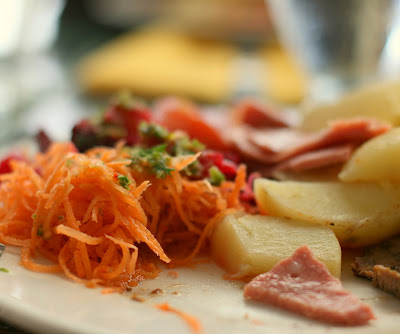

Carrot, beet and potato salad with spicy Jalapeno salad dressing.
Aside from enjoying the gastronomical delights, I was taken aback by the country's breathtaking vegetation. Everything is so colourful and vivid, just like these photos clearly illustrate. According to a good friend of mine, originally from India, the banana flower, also known as the banana blossom or the banana heart, shown on the top left hand corner, is pretty much edible. In India and Sri Lanka, it is either served raw with dips or cooked in soups and curries.

It all goes without saying: a country that gives you a full belly deserves a second visit.